

Listen Now


The commercial function, sitting at the intersection of customers, sales and marketing channels, and internal teams, is under unprecedented strain. Legacy systems, portfolio complexity, and a shrinking talent pool are surfacing long-standing inefficiencies, resulting in fragmented insights, slower decisions, and lost commercial momentum.
AI presents a clear opportunity to break through these constraints. When deployed effectively, it automates low-value work, delivers real-time visibility into critical KPIs, and augments decision-making across the commercial organization. Done right, AI shifts commercial teams from reactive execution to predictive, growth-oriented performance.
Inside the Industrial Commercial Organization
The commercial function connects R&D, operations, finance, and supply chain with customers, partners, and distributors—translating what a company builds into what the market values. Inmost industrial organizations, it revolves around three core roles:
- Sales: Drives customer acquisition, retention, and expansion across direct and distributor-led models.
- Product Management: Bridges operations and the market—shaping offerings, pricing, and margin strategy.
- Channel Marketing & Sales Operations: Links strategy to execution through partner programs, demand generation, forecasting, and performance management.
Alignment across these roles is essential—but increasingly difficult.
Commercial Challenge in Industrials
Industrials face structural constraints that weigh heavily on commercial performance:
- Disjointed Systems: 98% of manufacturers report major data issues, from outdated data to incomplete information [1]
- Shrinking Talent Base: 97% worry about knowledge loss and 60% list talent attraction and retention as their top challenge[2].
- Complex Portfolios: Nearly 60% of manufacturing part portfolio could be rationalized[3].
- Lengthy Sales Cycles: Industrial sales are contract heavy, often spanning three to six months.
- Rising Costs: Wage and raw material pressures continue to build
- Digital Lag: Two-thirds of industrial firms struggle with digital conversion and ROI[4].
These challenges show up differently across roles (Exhibit 1)—sales lack timely customer and pricing data, product managers facepoor visibility, and channel operations struggle to forecast demand or measure spend effectiveness.
Exhibit 1
These challenges provide multiple opportunities, addressing which, teams can unlock substantial productivity

Opportunities to Transform the Commercial Function with AI
Advances in AI now allow industrial companies to unify data, streamline workflows, and embed intelligence directly into commercialdecision-making—shifting the function from reactive execution to predictive growth.
1. Reimagining Sales
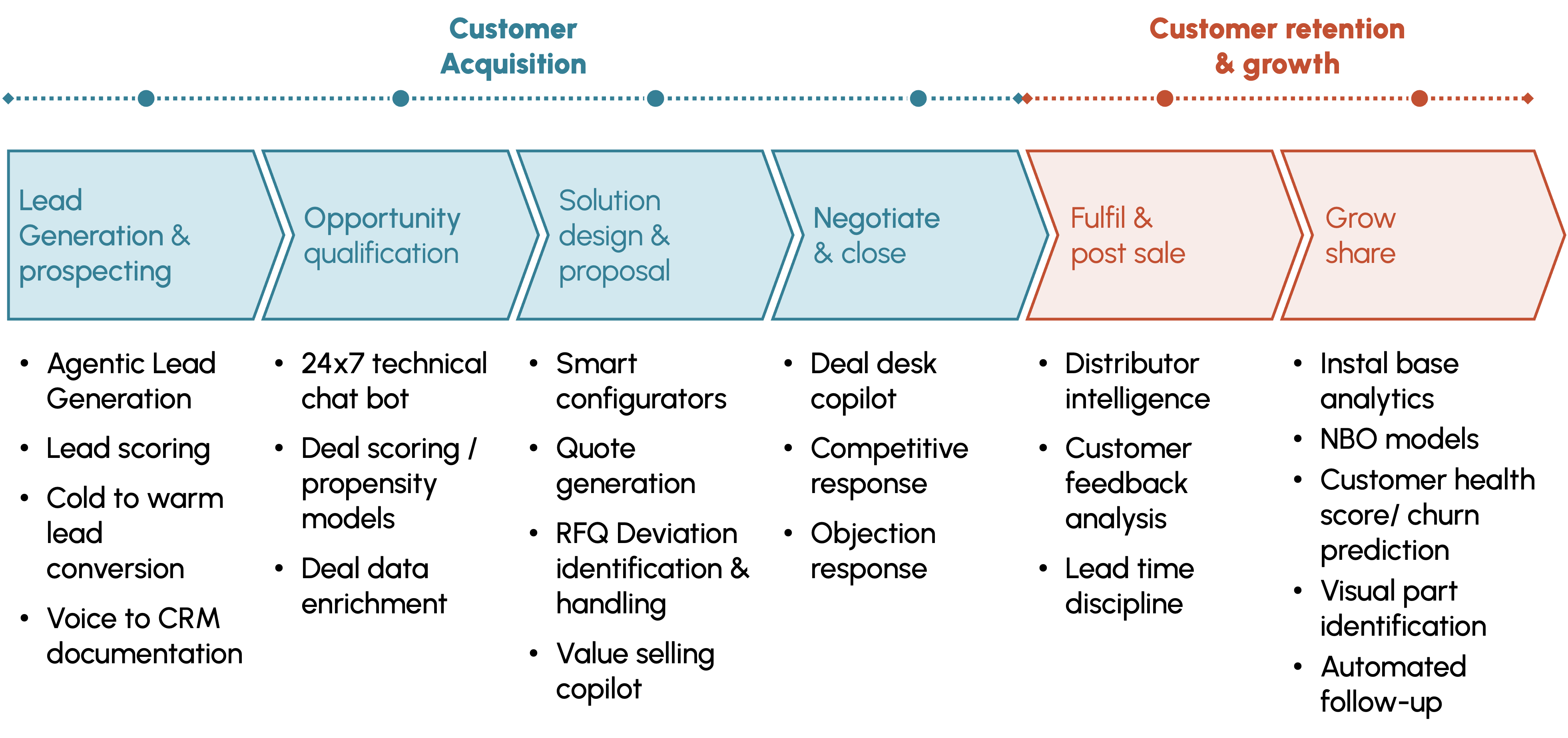
AI enables intelligence at every stage of the customer journey (Exhibit 2)—allowing sales teams to stop chasing information and focusinstead on relationship-building, prioritization, and deal velocity.
Exhibit 2
Sales view: AI applications across the sales lifecycle
2. Empowering Product Management
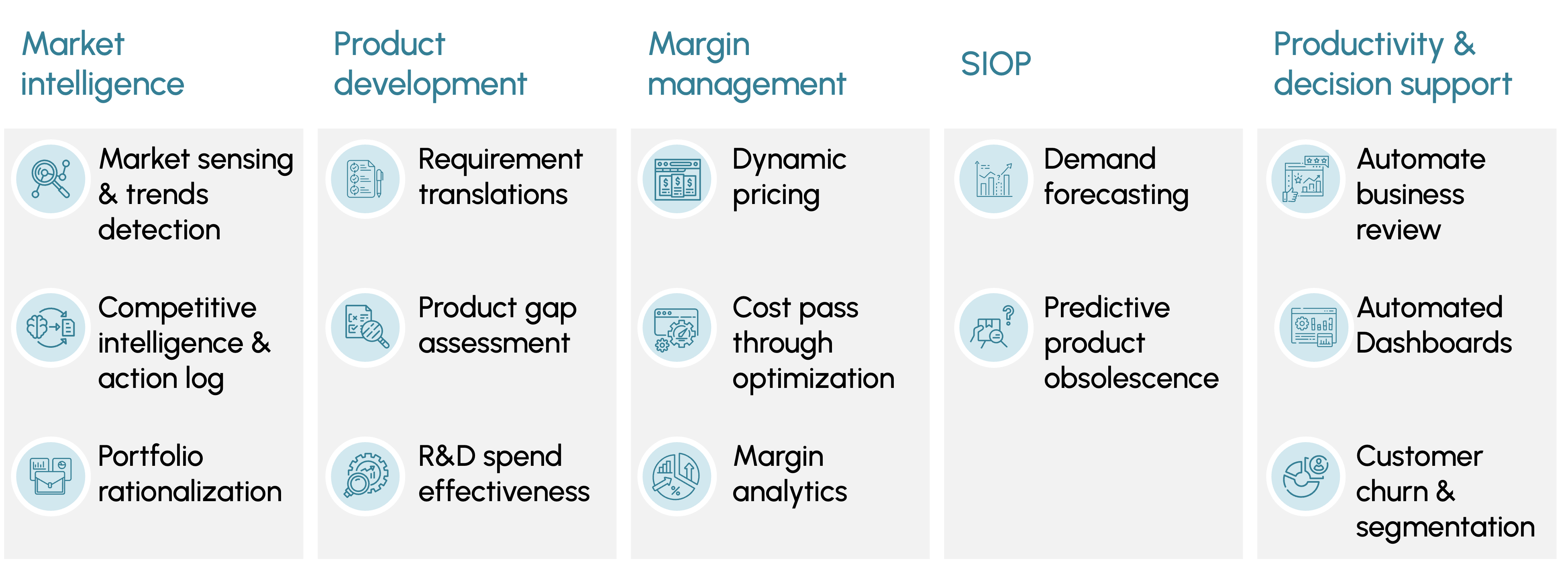
AI removes the visibility constraint for product managers by delivering real-time insight into demand, margins, and trade-offs—enablingfaster decisions and tighter alignment between operations and market needs (Exhibit 3).
Exhibit 3
Product Manager’s perspective: Emerging use-cases that can unlock productivity & better decision making
3. Transforming Channel Marketing & Sales Operations
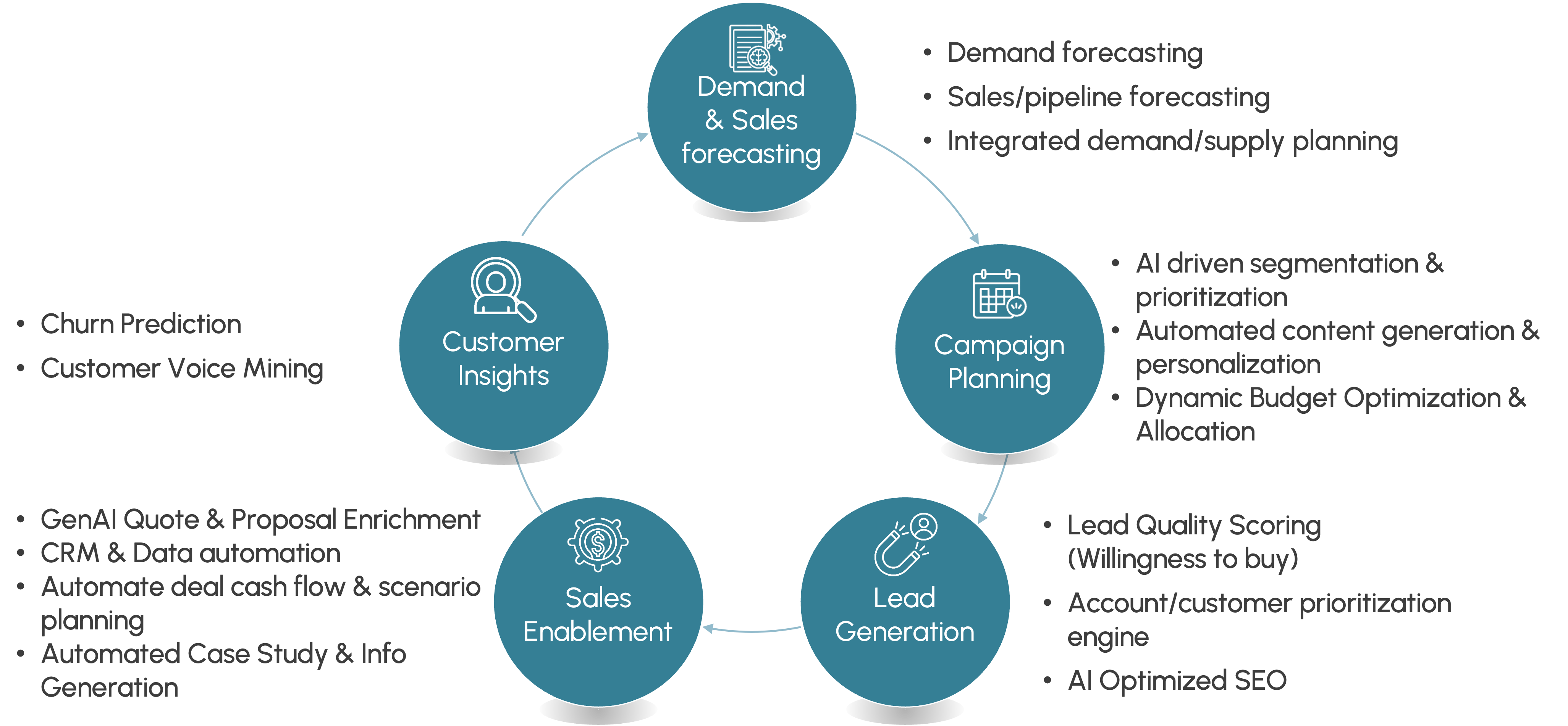
AI allows channel and sales operations to dynamically allocate spend, sharpen ROI visibility, and evolve into self-optimizing systemsthat adjust in real time based on performance signals (Exhibit 4).
Exhibit 4
Channel Marketing & Sales Operations: Transforming each step of the sales operations cycle
AI In Action in Transforming Commercial Function
Early adopters are already seeing impact. One example is AI-powered digital product configurators (Exhibit 5). Traditionally, responding to RFQs is slow and resource-intensive. AI automates configuration and quoting—generating compliant product options and full quotes in minutes rather than weeks.
Exhibit 5
Smart Configurator: Transforming customer experience by collapsing RFQ response time from 2-4 weeks to 1 day
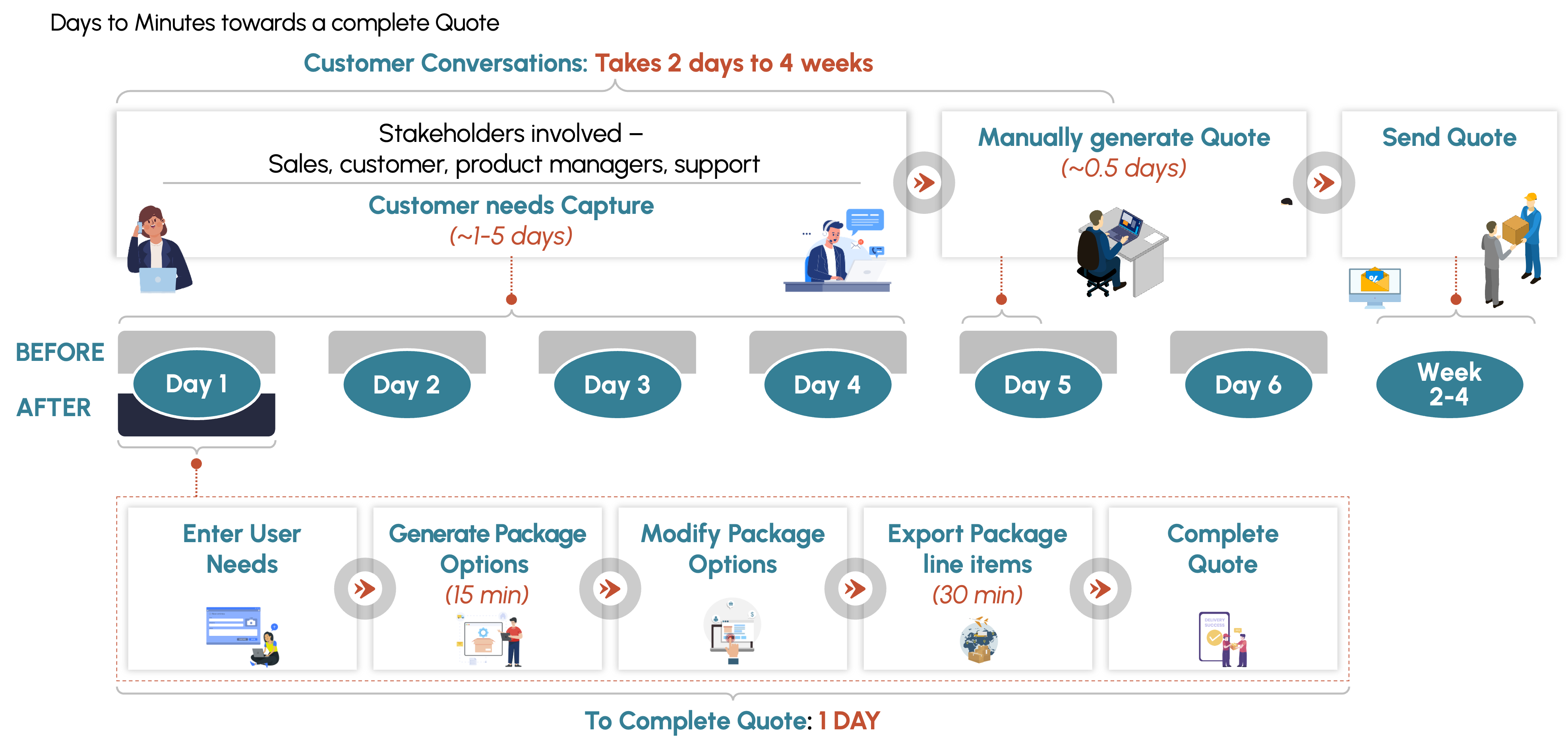
The impact is transformational. Sales teams can respond to complex requests faster, product managers are free from repetitive queries, and customers receive quotes instantly. This dramatically boosts time saved, customer satisfaction, and win rates.
Prioritizing AI Investments in Commercial Excellence
With many potential use cases, knowing where to start matters. Not all opportunities deliver equal impact.
Three Dimensions of Prioritization
Successful deployment requires analyzing three critical dimensions (Exhibit 6):
- TechEase: How readily can the use case be implemented given data availability, system maturity, and integration requirements?
- Compounding Effect: How widely does the use case influence the organization—spanning roles, functions, or business units?
- Tangible Impact: How much does the needle move on core outcomes such as revenue growth, cost reduction, or time savings?
Exhibit 6
Solving for impact, low technical load, & prospect of organization scalability will provide early wins & demand for broader adoption
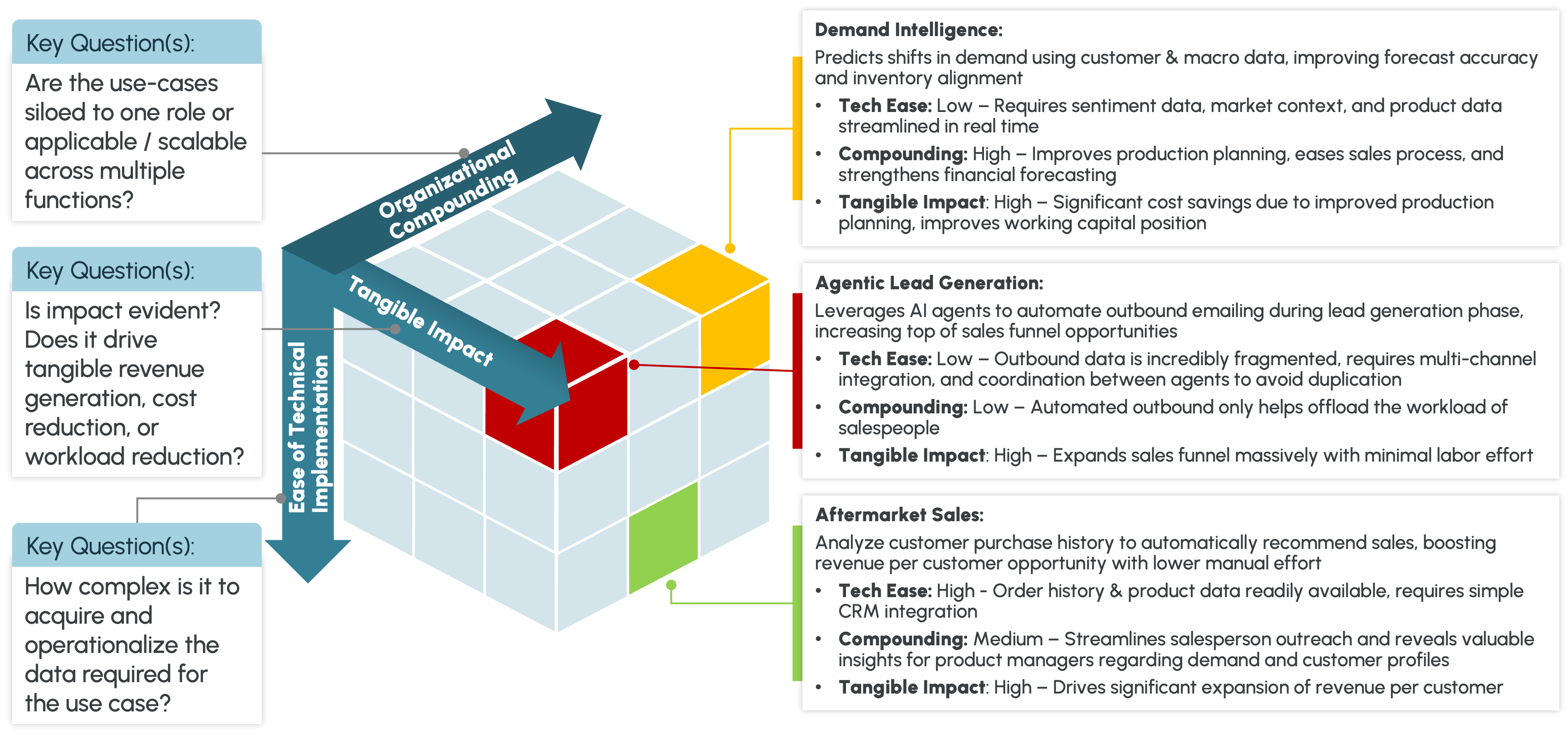
The highest returns sit at the intersection of accessible data, scalable impact, and clear business outcomes. A disciplined prioritization approach enables near-term wins while building the foundation for sustained commercial transformation.
[1] “A Deep Dive into Data, Collaboration and Automation Advanced ManufacturingReport.” n.d. Accessed November 5, 2025.https://static1.squarespace.com/static/6500be7b90b0f770653f355f/t/6776b4c4384338357ee0086a/1735832814406/Hexagon+-+2024+Advanced+Manufacturing+Report.pdf.
[2] National Association of Manufacturers. 2019. “The Aging of the Manufacturing Workforce:Challenges and Best Practices.”https://www.themanufacturinginstitute.org/wp-content/uploads/2020/03/MI-Sloan-Aging-in-the-MFG-Workforce-Report.pdf.
[3] CADDiCo Ltd. 2018. “Parts Proliferation: The Junk Drawer of Manufacturing Chaos.”Caddi.com. CADDi | Manufacturing Intelligence Made Simple. 2018.https://us.caddi.com/resources/insights/parts-proliferation-the-junk-drawer-of-manufacturing-chaos
[4] Harris, Nathan. 2025. “Manufacturing Marketing Challenges of 2025 (and How to FixThem).” Npws.net. May 23, 2025.https://www.npws.net/blog/manufacturing-marketing-challenges